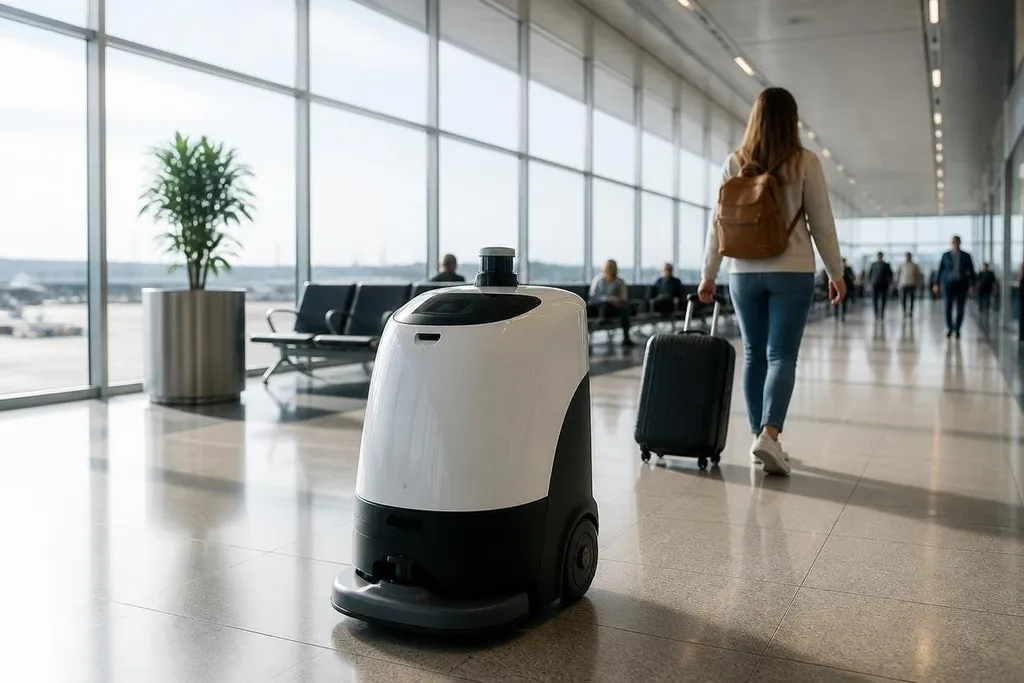
Airport robots are being discussed as tools for cleaning, delivery, passenger guidance, luggage handling, and inspection. Without a named airport, robot model, trial date, or measured result, though, no honest article can say how much they have changed air travel.
A useful report must connect each robot to a job, a person, and a result.
- Task: what the robot does and where it works
- Proof: the airport, model, trial date, and measured result
- Limit: the task the robot still needs people or airport systems to handle
Start with the job
An airport is a difficult place for autonomous systems. Passenger numbers change by the hour, routes can close, floors get wet, and people may stop without warning. A robot that moves through a quiet corridor faces a different problem from one that carries bags beside a busy gate.
That makes the job more useful than the shape of the machine. A low platform carrying supplies, for example, needs safe movement, clear routes, and a way to stop when a person steps in front of it. A guide robot needs accurate directions and a way to handle a closed checkpoint or moved gate.
The question for each case is plain: what work does the robot remove, reduce, or make safer? If the answer is not tied to a named task, the claim is too broad to judge.
The systems around the robot
An airport robot rarely works alone. Its results can depend on doors, lifts, charging points, wireless networks, baggage software, security rules, and staff who respond when the machine stops.
That connection matters because a robot can complete its movement and still fail the wider job. A delivery robot may reach a service area, but the trial also needs to show how staff load it, how they receive the items, and what happens when a route closes.
At an airport, a closed corridor or security check can change the result before the robot reaches its destination. Airport robotics reports from Robot24.com can place those limits beside the named system and measured result, so the next claim starts with what the robot did, not what the maker hoped it would do.
A useful report should name the system beside the result. It should also state what the source measured, rather than turning a maker's goal into a completed outcome.
What passengers may notice
The passenger may never see a robot at work. The effect could appear as a cleaner floor, a delivered meal, a shorter walk for a person who needs help, or staff spending more time on exceptions.
That last part matters. Airport work includes many cases that are hard to predict: a damaged bag, a missed connection, a blocked lift, or a passenger who needs a different route. Robots may handle repeatable movement, while staff deal with decisions and unusual events. A report needs evidence before assigning either side a wider role.
Passenger comfort also needs a direct test. Does the robot leave enough room in a narrow passage? Can a person understand its warning sound? Does it stop at a safe distance? A speed figure alone cannot answer those questions.
What remains unproven
The missing details often decide whether a trial matters. An airport may show a robot completing a task, but that does not show how often it works, how much staff time it needs, or what the service costs.
I'd judge airport robots by repeated task results, not by a single smooth video. A useful report should also state what the public cannot yet verify, such as the number of shifts, failed runs, safety stops, or sites involved.
Use this check before accepting a claim about an airport robot:
- Name the site: record the airport and the area where the robot worked.
- Name the model: check the maker, robot type, and task equipment.
- Record the measure: look for trips, hours, stops, errors, or completed jobs.
- Check the people: note who loads, supervises, repairs, and helps passengers.
- Find the limit: write down the cases the robot cannot handle alone.
The next useful airport robot story will include a task, a place, a date, and a result someone else can check. Until those details appear, the machine may be ready for a trial, but air travel has not yet changed by much.